Microsoft Partner Makes the Shift to 'Internet of Things'
The emerging opportunity for partners to help their customers tap into the Internet of Things (IoT) was recently confirmed by Microsoft's addition of the Intelligent Systems competency.
The cloud play for IoT -- providing a secure place for all the data to live -- is an obvious partner opportunity, but the service opportunities are where it gets really interesting. As always, there are partners who are leading the way to help solve business problems and take advantage of the latest technology.
A Shift in Thinking
Emily Lynch, VP of marketing at Catapult Systems, a multi-gold Microsoft National Systems Integrator (NSI), is uniquely qualified to talk about the shift in thinking that IoT requires. Before moving into enterprise sales and marketing, Lynch was a chemical engineer in the field of manufacturing automation. She's also spent time in China, where IoT is further along the adoption curve.
"The concept of Internet of Things has existed for a long time in the manufacturing world, with distributed control systems gathering data from sensors in thousands of locations," Lynch noted. "The current idea of IoT is just an expansion of that idea. We are gathering intelligence from devices and sensors -- everything from building temperatures to your pet's whereabouts."
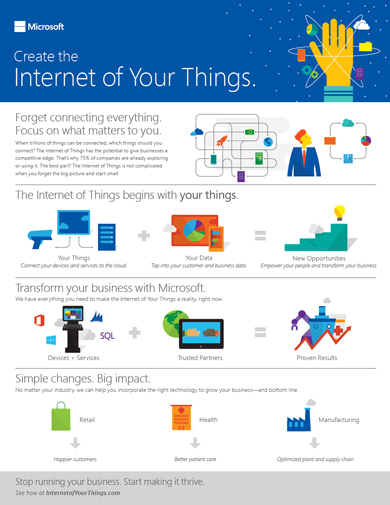 [Click on image for larger view.]
Microsoft's "Internet of Things" infographic.
[Click on image for larger view.]
Microsoft's "Internet of Things" infographic.
With the growing ecosystem of IoT collecting more and more data, businesses must find the ways to interpret and put that information to work in a usable form.
"At Catapult, we are learning how to shift our thinking," Lynch explained. "Gathering intelligence from hundreds of different endpoints, we need to build applications that can combine that intelligence and deliver it to help businesses make better informed decisions. We are just getting started imagining the possibilities."
User-Focused Services
Catapult's clients are recognizing their ability to store and access large quantities of data in the cloud, which is driving a move to Microsoft Azure. Since that data is coming from different systems, integration services lead the initial customer-requirement discussions. But the real change in service delivery supports end user data consumption.
"We are growing our user-centered design practice at Catapult. Projects are getting extended to create the appropriate dashboards or slimmed down workflow applications for the end user in the field," Lynch said. "IoT is worthless for all for us if it doesn't drive efficiency. And you can't drive efficiency if you don't have adoption. User-centered design is the big lever in the proliferation of IoT."
Catapult is making inroads with clients, building real-world evidence. In one project for a multi-state car dealership, Catapult is tapping into the IoT for processes across the business. Handheld devices allow the mechanics in the shop to place orders for parts as they work. Purchase requests are automatically rolled up across the company to drive buying efficiencies with the parts suppliers. In the showroom, sales people can use tablet devices to show customers current inventory across the dealership's lots. The marketing department is using IoT data to advertise specific cars in inventory to targeted customers based on past purchases.
The Customer Conversation
Explaining the potential of the IoT to customers is not an easy task. During live events, Catapult is introducing messaging on mobility and IoT to customers and prospects. Adding an IoT component to its Microsoft Experience Centers (MECs) scenarios, Catapult is also showing participants how IoT would impact their businesses.
Lynch believes that many businesses are conceptually further along with IoT than with actual implementations because the devices that collect and deliver the data are changing so quickly. Mobility and the explosion of table options are driving many of the client conversations. As with many advances, the user technology is still catching up to the vision.
The Partner Opportunity
IoT will undoubtedly provide service opportunities to partners on many levels, including increased demand for data storage in the cloud, the need for integration services, and transformation of the data into usable intelligence. This is the time to get ahead of the curve and help customers understand the real-life application to their businesses. Demonstrate the business value of translating data into user-friendly information delivered to the front lines of work.
What services are you providing around IoT? Add a comment below or send me a note and let's share your story.
Posted by Barb Levisay on May 21, 2014