News
Microsoft Recasts Windows as a Platform for AI Agents at Build 2026
- By David Ramel
- June 02, 2026
Microsoft’s Build 2026 Windows developer news made clear that the company sees agentic AI as a core Windows platform shift, not just another layer of Copilot-style assistance. The announcements centered on agents that can create apps, issue shell commands, run workflows, use local models, and operate within enterprise policy controls.
In a Windows Developer Blog roundup, Microsoft framed the work as part of a broader push to support AI workloads across device and cloud environments with a developer-optimized Windows 11 experience to build and ship faster. Some key launches include Coreutils for Windows, WSL containers, Intelligent Terminal and Windows Developer Configuration.
The central message for developers was not one new agent framework, but a stack of Windows capabilities designed for agents that can take action. Microsoft summarized the shift directly in the roundup: "As AI becomes integral to how software is built and shipped, the platform must evolve too. That's why we're taking the next step: making Windows the best place to build and run agents."
Agentic Workflows Move Into Native Windows Development
One of the most direct developer-facing pieces is Windows Development Skills, now generally available. Microsoft said the feature is intended to let agents use "structured knowledge" across the lifecycle of building a native Windows app with WinUI 3 skills and the WinApp command-line interface.
A related Microsoft GitHub repository shows how concrete that agentic Windows development push has become. The repo describes WinUI agents and skills for GitHub Copilot, Claude Code and OpenAI Codex, covering the "end-to-end inner loop: scaffold → design → build → run → test → package → ship." It also lists skills for development workflow, design, code review, UI testing, packaging, WPF migration, session reporting and setup.
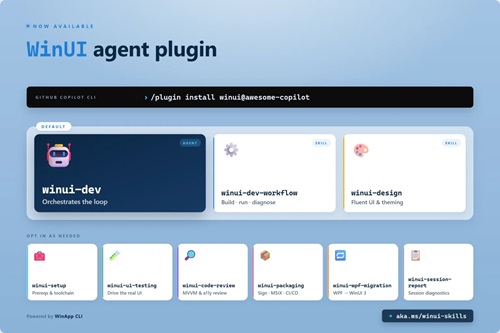 [Click on image for larger view.] WinUI Agent Plugin (source: GitHub).
That's a new practical Windows developer angle. Rather than asking a general-purpose coding agent to infer platform-specific patterns, Microsoft is adding Windows-specific application development knowledge intended to help agents build native Windows apps more efficiently. The company described the goal as helping agents work across the "full lifecycle" of native Windows app development.
Microsoft also announced an experimental Intelligent Terminal 0.1, described as an open-source experimental fork of Windows Terminal with native agent integration. The terminal adds an agent status bar, an agent pane, automatic error detection and support for Agent Client Protocol-compatible agents. GitHub Copilot CLI is the default agent experience, but Microsoft said developers can configure other compatible agents.
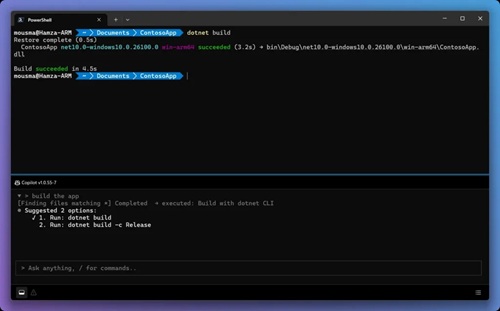 [Click on image for larger view.] Intelligent Terminal (source: Microsoft).
The Intelligent Terminal post describes the agent pane as "your pair-programmer in the shell," with access to shell output so developers do not have to copy errors into browsers or separate agent sessions. When a command fails, the terminal can load the relevant context into the agent pane so the agent can explain the failure and suggest or run a fix.
That makes Intelligent Terminal notable not because it replaces an integrated development environment, but because it puts agentic assistance into another part of the developer workflow. The shell already contains command output, failed builds, package manager errors, Git state and project context. Microsoft's experiment is to make that environment directly accessible to agents.
Security Becomes a Platform Requirement for Agents
The other major thread is containment. In a separate Windows platform security post, Microsoft said agents are "no longer just answering questions" and are increasingly taking actions across systems. The post described agents that read files, invoke services, modify environments and chain operations together, raising new trust and control issues.
That is the context for Microsoft Execution Containers (MXC), an early-preview SDK and policy-driven execution layer for agents on Windows and Windows Subsystem for Linux (WSL). Microsoft said developers define what to constrain in their apps and agents, and Windows enforces those constraints at runtime through MXC.
The MXC GitHub repository describes the project as "a sandboxed code execution system for running untrusted code (model output, plugins, tools) on Windows, Linux, and macOS." It also notes that the repository contains early-preview code and says no MXC profiles should currently be treated as security boundaries.
Microsoft's security post laid out several containment levels, including process isolation for coding-agent scenarios, session isolation for longer-running workloads, and future roadmap work around micro-VMs, Linux containers and integration with Windows 365 for Agents. The post said GitHub Copilot CLI has adopted MXC process isolation "to constrain what dynamically generated and executed code can do."
The article also included partner quotes focused on agent execution and containment. David Wiesen, member of technical staff at OpenAI, said: "Working with Microsoft on the Microsoft Execution Containers (MXC) allows us to explore new patterns for AI agents to safely and efficiently generate and execute code. By combining Codex's capabilities with MXC's execution environment, we aim to help developers move from intent to reliable execution faster, while maintaining the security and control enterprises need."
Microsoft summed up the security issue in production terms: "The value of an agent is not just what it can do, but whether it can be trusted in production."
Windows 365 Gives Agents a Place To Act
Microsoft also connected agentic AI to Cloud PCs through Windows 365 for Agents. The Microsoft Learn documentation says agents sometimes need a full operating environment when a task cannot be completed through application programming interfaces alone.
Within Agent 365, Windows 365 for Agents acts as an execution layer for computer-using agents. Microsoft said an agent can obtain a Cloud PC and carry out actions in a Windows session, while Windows 365 handles provisioning, session lifecycle, isolation and operational reliability. The documentation says this is intended for scenarios such as interacting with desktop or web apps that lack reliable APIs, performing UI-level actions, supporting human-in-the-loop workflows and operating inside environments governed by Microsoft Entra ID, Microsoft Intune and Conditional Access.
That gives Microsoft a cloud-side answer to the same agent problem MXC addresses locally: agents need environments where they can act, but those environments need controls, identity, policy and auditing.
Local Models and Agent-First Devices Extend the Strategy
Microsoft also announced Aion 1.0 Plan, a 14-billion-parameter reasoning and tool-calling model with a 32K context length that the company said will ship in-box as part of Windows on capable devices. Microsoft said the model enables applications to reason over user intent, invoke tools, manage files and orchestrate sub-agents, "bringing fully agentic workflows onto the device."
That local-model announcement sits alongside Microsoft's expansion of Windows AI APIs beyond neural processing units (NPUs) to CPUs and GPUs. Microsoft said the move will bring local AI experiences to more Windows 11 devices, including support for the Windows inbox small language model on capable GPUs and Video Super Resolution and Speech Recognition on CPUs.
Microsoft's Build Live coverage also introduced Project Solara as "a chip-to-cloud platform designed for an open, multiple agent world." Microsoft described Solara as an early look at a platform for agent-first experiences, rather than a developer tool developers can use today.
The Solara mention broadens the story from Windows developer tooling to future agent platforms and devices. But for developers working in the Microsoft stack, the more immediate Build 2026 story is that Windows is being prepared for agents that can write code, run commands, operate in Cloud PCs, use local models and work inside policy-defined boundaries.
The AI Shift
Microsoft's Build 2026 Windows news suggests a shift from AI as an assistant inside tools to AI as an actor across the operating system. The company's announcements span app-building guidance for agents, terminal integration, local agentic reasoning, Cloud PC execution and containment enforced through Windows and WSL.
That leaves several technologies at different maturity levels. Windows Development Skills and Windows Developer Configurations are generally available. Intelligent Terminal is experimental. MXC is in early preview. Aion 1.0 Plan is coming in the coming months. Project Solara is an early platform look.
The common thread is agentic AI as a platform concern. Microsoft is not just adding more Copilot surfaces. It is laying out Windows components for agents that can take action -- and for organizations that need to decide what those agents are allowed to do.