News
New Azure SQL Database Service Tiers Coming September
- By Gladys Rama
- August 28, 2014
Microsoft is planning to roll out its new service tiers for Azure SQL Database sometime next month with a new pricing plan, the company said on Wednesday.
First launched in preview in April, the new service tiers -- Basic, Standard and Premium -- will signal the phase-out of the older Web and Business tiers. Those two tiers will be retired in September 2015, one year after the new tier structure kicks in.
The Basic tier, which has a database size limit of 2GB, is designed for applications with lighter transactional workloads. The Premium tier has the highest size limit at 500GB and is aimed at mission-critical databases. Standard, which is designed to be the "go-to option for getting started with cloud-designed business applications," falls between the two with a 250GB limit.
Since releasing the tiers in preview, Microsoft has made several changes, including increasing the uptime SLA for all tiers from 99.95 percent to 99.99 percent. Microsoft is also slashing the prices for the Standard and Premium tiers by 50 percent. The new tiers will also move to hourly billing. The updated pricing will take effect for all customers starting on Nov. 1.
In addition, Microsoft has added a new S0 performance level for the Standard tier. Priced at $15 per month, the Standard S0 level "will enable more customers to benefit from the features in the Standard tier," Microsoft said in its announcement.
The Microsoft table below summarizes the three tiers.
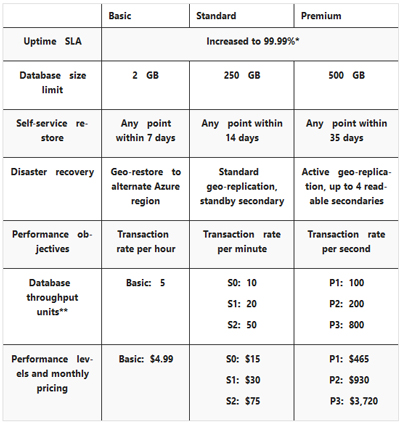 *99.99% uptime SLA does not apply to SQL Database Web or Business editions which are supported at 99.9%.
**Represents a blended measure of CPU, memory and read and write rates. For further details, click here.
An upcoming service update will introduce functionalities aimed specifically at ISVs, though Microsoft did not elaborate on when it will be released.
"[W]e've heard from some ISVs, which have a large number of databases with variable performance demands, that they need the flexibility to share performance resources across these databases as opposed to managing resources for databases individually. For example, some SaaS ISVs may have a separate SQL database for each customer and as the activity of each database varies, they want to manage a pool of resources with a defined budget across these customer databases. We are working to enable this scenario within the new service tiers in a future service update," the company said.