Where We Stand on Windows XP: Market Share Check
With a month to go to the April 8 support deadline, is Windows XP fading away or hanging on? Depends whose data you look at.
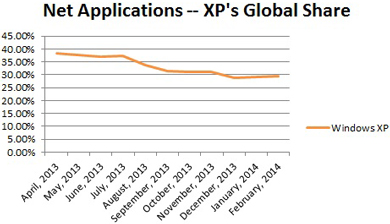
Net Applications reported its data this week, and it shows that through February, Windows XP not only stuck around but gained a little share for the second month in a row. According to Net Applications, Windows XP went from 28.98 percent share of desktop operating systems worldwide in December up to 29.3 percent in January and then 29.53 percent in February. The figures show Windows XP dropping in a stair-step pattern from the high 30 percent range through July, then settling around 31 percent in September and October before dropping into the 29 percent range, where it's stayed the last three months. Despite the impending deadline, there's no evidence of a precipitous drop due to late movers.
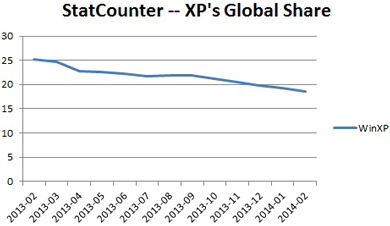
Another market research firm shows a different trend, with Windows XP steadily falling away. StatCounter has shown Windows XP's global share to be much lower over the course of the last year -- starting out last February at only 25 percent and dropping relatively smoothly to 18.6 percent for February 2014.
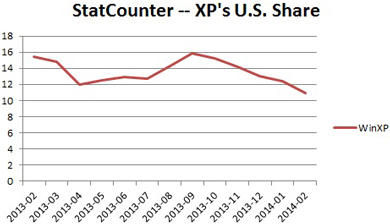
Domestically, StatCounter puts Windows XP's usage share even lower. The OS had a weird trough where it dropped from February 2013 to April 2013 then started climbing again. But since reaching nearly 16 percent share in September, StatCounter has shown XP's usage share falling rapidly to 10.93 percent in February 2014.
Both track browser information, although StatCounter uses pageviews while Net Applications uses unique visitors, among other differences in their approaches.
It's hard to say what's accounting for the difference, but one other metric tracked by Net Applications hints at an interesting possibility.
Net Applications also tracks browsing by device type and the last few months have seen a strong gain in the "mobile + tablet" browsing category at the expense of desktop browsing.
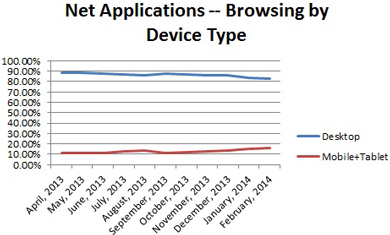
Could we be looking at Windows XP users continuing to access the Web at similar rates as in the past, while adopters of newer operating systems are increasingly browsing with tablets and smartphones? Could that give Windows XP an apparent bump in desktop share even as the old OS' share is actually dropping?
Either way, it's a difficult situation for Microsoft. One possibility is that Windows XP share isn't falling, in which case Microsoft faces stark choices about its responsibility for the security of the entire Internet, not just customers who don't upgrade, as the pool of Windows XP machines becomes an unprotected haven for botnets and other malware. The other possibility is that mobile browsing, in which Microsoft is still not a significant player, is really taking off.
For more on Windows XP's support deadline, go here.
Posted by Scott Bekker on March 06, 2014