News
Microsoft Outlook and Teams Service Problems Fixed
- By Kurt Mackie
- June 28, 2023
Microsoft indicated that it fixed service issues with Outlook on the Web on June 27, followed by Microsoft Teams issues on June 28.
Microsoft ascribed the Outlook on the Web issues to a problematic build change and indicated that its fix had mitigated the service problems. The issue had been thought early on to be confined to the North American service area, but Microsoft later said that it was more widespread, without being specific. Account administrators were told to check the Service Health Dashboard "under EX610644 for more details."
The Teams problems were said to have blocked user Teams access via Web browsers, although some respondents to Microsoft's Twitter posts had indicated that desktop and mobile clients were affected, too. A configuration change was the cause of the service problems, which Microsoft subsequently reverted. Services then started to become available again in "America, Asia-Pacific and Europe, Middle East and Africa regions," Microsoft's Twitter posts had explained. Microsoft had directed account administrators to find further details under "TM6712617 in the admin center."
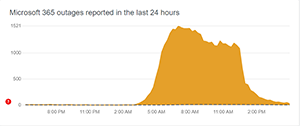
Crowd sourcing by Downdetector.com showed overall Microsoft 365 outage complaints starting to peak at 5:00 a.m. and ending around 2:00 p.m. on June 28, but it's unclear which service outages were being represented (see chart below).
 [Click on image for larger view.]
Figure 1. Microsoft 365 outages for June 27 to June 28, 2023, approximately (source: Downdetector.com).
[Click on image for larger view.]
Figure 1. Microsoft 365 outages for June 27 to June 28, 2023, approximately (source: Downdetector.com).
Exoprise, a company that tracks service outages using customer crowdsourcing and headless browser sensors, wrote about the Microsoft Teams outage (TM612617) in a blog post. Exoprise estimated that the Teams outage had "lasted about 2 hours including the time to roll out a fix." The Teams outage started at 6:53 a.m. EDT and ended at 8:55 a.m. EDT on June 28, per Microsoft. The Teams users who were affected had been "served through the affected infrastructure and are not using a cached desktop build," Microsoft explained.
Exoprise contended that its customers knew about the Teams problems "35 minutes before Microsoft."
Both service outages this time appear to have happened due to problematic updates or configuration changes applied by Microsoft. In early June, Microsoft reported Outlook on the Web and Azure Portal service interruptions, which were loosely ascribed to a distributed denial of service attack from a group called Anonymous Sudan.
Microsoft 365 service issues have seemed prominent for the month of June, although those services do go down all of the time. Microsoft mostly provides the details about such incidents to account administrators, rather than the general public. In such cases, Microsoft offers downtime service credits via its service level agreements, although organization have to apply to get the credits.
About the Author
Kurt Mackie is senior news producer for 1105 Media's Converge360 group.