News
Intel Taps Brian Krzanich as New CEO To Replace Otellini
- By Gladys Rama
- May 02, 2013
Intel on Thursday named current chief operating officer Brian Krzanich as its next CEO, and software chief Renée James as its next president.
Krzanich replaces current CEO and president Paul Otellini, who is expected to retire this month. Krzanich will officially become Intel's sixth CEO on May 16, during Intel's annual stockholders meeting, according to Intel's announcement. James, a 25-year Intel veteran, will also assume her new role as president on May 16.
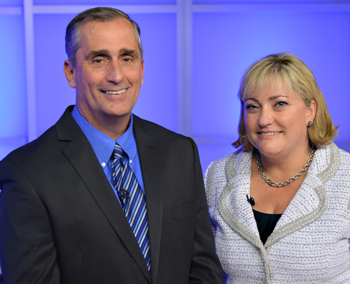 Intel CEO-elect Brian Krzanich (left) and president-elect Renée James.
"I am deeply honored by the opportunity to lead Intel," Krzanich said in a prepared statement. "We have amazing assets, tremendous talent, and an unmatched legacy of innovation and execution. I look forward to working with our leadership team and employees worldwide to continue our proud legacy, while moving even faster into ultra-mobility, to lead Intel into the next era."
Otellini, who has served as Intel's CEO since 2004 and its president since 2002, unexpectedly announced his intention to retire last November. He will remain available after his retirement in an advisor role, he said at the time.
Intel's board suggested that it would look at both internal and external candidates for Otellini's replacement, but it was widely expected that the company would hire from its own ranks. Industry watchers have observed that Intel has tended to hire CEOs who were previously COOs. Otellini himself served as COO for two years before being named CEO. Krzanich was named COO of Intel just last January.
A 31-year Intel veteran, Krzanich has held multiple executive positions in the company, particularly in its manufacturing divisions. According to analyst Jack Gold, Krzanich's appointment signals an effort by Intel to take greater advantage of its fabrication plants, or "fabs."
"Elevating him to the CEO [role] means increased focus on operations excellence, and not just engineering excellence. This is important as Intel needs to optimize its huge investments in its fabs," Gold said in an e-mail. "This needs to include filling those fabs by selectively bringing in outside work that gets utilization to higher levels and complements production of its core products. This should include offering leading-edge capacity to other chip vendors (which it does in a limited way currently), perhaps even to longer-term competitors (e.g., Qualcomm, Apple). This is being done successfully by others (e.g., Samsung fabbing Apple chips while competing), and could be done by Intel, as well, even if it's on 'one generation behind' technology (on which Intel is still ahead of most of the rest of the industry)."
Krzanich takes the CEO role as Intel seems to be adjusting its hardware approach in response to a shaky traditional PC market that coincides with rising demand for smaller devices. At its recent Q1 financial earnings call, Intel reported a 6 percent year-over-year decline for its PC Client Group. During the call, the company played up its next-generation processors, including "Bay Trail" and "Haswell", which are designed to enable new and cheaper form factors.