We literally love anything that's literal, so we couldn't let this little story pass by this week without some sort of comment. That nasty little torrent site, The Pirate Bay, has a brilliant idea for avoiding the intrusive copyright laws of planet Earth.
Put the servers in the sky, somewhere up there where Norman Greenbaum says he has reservations. That's actually what The Pirate Bay folks (apparently, "The" is part of the name) say they're going to do. They seem to be entirely serious when they say that they're going to locate servers in unmanned drone aircraft that will hover above Sweden. That way, their ostensibly illegal stuff will escape the jurisdiction of everybody but a few birds. Yes, this is literal cloud computing.
And it's brilliant, right? Forget about the illegal part. This could be the solution to the pestering problem of how to build and cool datacenters. Just launch them! Over Sweden! What could possibly go wrong, aside from the term "crash" becoming a little more literal? (And, again, we love the literal at RCPU.)
Forget about painting the roof of your datacenter white or figuring out a way to cool those burning-hot server farms. Just throw everything up in the air and let it gently float around us. You can get your kids to control your drones with remote controls.
Actually, this reminds your editor of a story. While living in France a few years back, your editor was admiring some of the military technology on display after the July 14 parade. He spotted what looked like a small airplane and, figuring it did something awesome, asked a French soldier, "What does this do? Blow things up or shoot lasers?" Befuddled, the soldier replied, "No, it takes photos." Photos. Never mind, then. Whatever.
Anyway, the server drone is brilliant. And folks at The Pirate Bay are pretty sure nobody will mess with it because they say shooting it down would be an act of war. An act of war, over Sweden, brought on by possibly illegal downloads of such oppressive mediocrities as one of the Twilight movies or a Taylor Swift album. Now just try telling us we don't live in the greatest era ever in human history.
Posted by Lee Pender on March 22, 20126 comments
Is it just coincidence that Microsoft's begrudging acceptance of open source, as slow, uneven and controversial as it has been, has coincided with the company's fall from its perch atop the technology mountain? Maybe, but there's no doubt that Apple, the company that has unseated Microsoft, has won its place as the world's most valuable company by also being the world's least flexible and most proprietary.
It has long been the case that a user who wants something from Apple has to get almost everything else from the company, too. Apple is about as open as a Border's bookstore. Once inside the company's gilded cage, it's hard to escape. That's fine most of the time because Apple's stuff famously just works. But there are a few exceptions, and one of them is iTunes. Great as it might be on the Mac, iTunes is an unstable and clunky resource gobbler on the PC. Still, once a user buys into iTunes -- and most have by now -- it's not usually worth the time and effort to get away from it and move to something else, even if the software does tend to crash like Duke in this year's NCAA basketball tournament.
No matter how bad iTunes might be outside its home court of the Mac, it's still the de facto organizer for most music and lots of longer videos. And of the many reasons Windows 8 might fail on tablets, it's likely near the top of the list. At this point, Apple doesn't seem interested in making a version of iTunes for Windows 8 tablets, meaning the user who's really into multimedia will either have to figure out some way to migrate (read: escape) from the software or just give up and buy an iPad.
iTunes is the one prison an outsider -- Microsoft, in this case -- would like to break into. But the guards at the gate are even tougher on visitors than they are on inmates. There seems to be no compelling reason for Apple to produce a version of iTunes for Windows 8's Metro interface, and there's little point in Microsoft trying to come up with an alternative, not matter how much better it might be. iTunes has Google-like brand recognition at this point and a fairly literal stranglehold on its user base.
All of this might sound a bit fluffy and consumer-focused, but folks who bring iPads to work are consumers, too. And while partners might -- just might -- be able to convince customers of Microsoft's tablet-readiness for the enterprise, it would be a bit like trying to sell a great car that only came with a tape deck (remember those?) or maybe with just a CD player and no iPod hookup. You see where we're going with this.
What are Microsoft and partners to do about this quandary? We have no idea. It's a bit of a chicken-and-egg scenario. It would be great if Microsoft could convince Apple that iTunes for Windows 8 Metro would be a great revenue driver (sort of like Office for Mac), but why would it? Nobody has bought a single Windows 8 tablet, while the iPad remains the Beatles circa 1964 of the technology industry. And with iTunes adding to its list of inmates all the time, where's the motivation for the industry's most closed company to suddenly open itself to a longtime competitor? We don't see it, either. Just as we don't see our music on iTunes because it just crashed again on our PC. But that doesn't really matter, does it?
What's your take on the importance of iTunes to Windows 8's tablet success? Send it to [email protected] or leave a comment below.
Posted by Lee Pender on March 19, 20123 comments
Frustration, from what we remember, is the experience of trying to reach a goal and then realizing that, no matter what you do, there is no way to reach it. It's also what a lot of people at Microsoft -- and Microsoft partners -- must be feeling right now with regard to Windows Phone.
No matter what Microsoft does, this anvil just keeps plunging deeper into an ocean of market share, falling further and further behind Google and Apple. Microsoft tried -- although not nearly for long enough, we'd say -- to compete straight-up with Android and iOS, but nothing has worked thus far.
Now, as we've noted before, Microsoft is taking the near-Soviet approach of dumbing down its offerings in hope of reaching a nonexistent swath of people who want cheap, crippled "smart" phones. Frustration is setting in, and desperation is creeping out.
We've gone over in this space many times the challenges Windows Phone faces, the most important being -- to us, anyway -- that despite being beautiful, it doesn't look like any other operating system that has come before it. Revolutionary change, unless Apple does it, often doesn't go over well in the technology industry, particularly with consumers. Microsoft has just started trying to launch a revolution with its new interface. Now, it's taking the battle in the wrong direction by making Windows Phone devices less capable, not more.
What that means is that Microsoft is yanking its starting quarterback in the first quarter and putting a lousy backup in to finish the game. (Yes, we're mixing metaphors today like tossing a salad, although your editor doesn't much like salad, usually.) The result is likely to be that Windows Phone will be a flop akin to the Kin, and the sad part is that it doesn't have to be that way. Instead of throwing in the towel, Microsoft should use some of its wads of cash to continue to boost Windows Phone's functionality, not cut it, and to educate consumers on why a Microsoft mobile OS that's completely new and different is worth a look.
What we're getting instead is more timidity from the new Microsoft. The company that once barreled over its competition in every market it entered is sadly gone. The new Microsoft, at least the new consumer Microsoft, flails, stumbles and waves the white flag at the first sign of trouble. That's a great way to be a loser for a very long time, and it's no way to inspire confidence in a partner base. But it's what we're seeing with Windows Phone, and we hope it won't seep into the rest of Microsoft's operation.
Continue to offer your take on dumbed-down Windows Phone devices in the comments or at [email protected]. And thanks.
See Also:
Posted by Lee Pender on March 08, 201216 comments
Multiple press outlets are reporting this week that former Microsoft Chief Software Architect Ray Ozzie says that "of course," we're in the post-PC era. But who cares? There's a much more important component to this story.
Ray Ozzie's new company is called Cocomo. Either we've already made fun of this here, or we forgot to make fun of it, or we forgot about the name altogether. But let's be very clear: The name Cocomo deserves ridicule. After all, nothing says forward-looking technology like a name that brings images (backwards, perhaps appropriately, in the case of this video) of an old song sung by an even older band.
Besides, Kokomo, the tune, always reminds your editor of a friend's very Bostonian mother, who used to sing, "Aruber, Jamaicer, ooh I want to take ya to Bermuder, Bahamer ..." So, thanks for that, Ray. But, really? Cocomo? Bodies in the sand, tropical drink melting in your hand ... and world-class enterprise software! Pina colada-flavored Skittles for everybody! (Software developers just love their Skittles, in case you'd forgotten.)
Posted by Lee Pender on March 08, 20121 comments
You can't begin to imagine how flattered your editor felt when he saw MWC news popping up all over the Web earlier this week. Texas Christian University, your editor's alma mater, might be leaving the humble Mountain West Conference for the greener prairies of the Big 12 in the fall, but TCU does leave the MWC with four football championships in seven years in the conference. And now the worldwide press wants to write about this? That's flattering.
Of course, it wasn't really flattering because MWC in this case stands for Mobile World Congress, a name that we at RCPU find very confusing and borderline insulting. Couldn't it be the Mobile World Expo or something? Is it really a congress? We hate when real-world abbreviations copy the well-known names of college football conferences. (We're looking at you, Securities and Exchange Commission.)
In any case, this week's event in Barcelona gave Microsoft a chance to show off Windows Phone, which is kind of like showing up for a Super Bowl party when everybody else has moved on to March Madness -- a Super Bowl party in 2010, that is. But we digress. Microsoft talked up its mobile operating system in Barca and also revealed a bit about how it's going to try and actually sell it. And when we heard that part of the story, we started to wonder whether Microsoft had paella on the brain. (OK, so paella is Spanish and not really Catalan, but we couldn't come up with a famous Catalan dish. No offense intended.)
Check out this nugget from CNET:
"The software giant said today that it had lowered the minimum requirements to build a Windows Phone, a move that allows vendors to construct less-expensive devices that can appeal to more budget-conscious customers and first-time smartphone buyers."
Allow us a diversion here. It'll make sense eventually. Soccer is not a particularly popular sport in the United States for lots of reasons. One of them is that the level of the game we play here is considerably below that played in Europe and South America, for the most part. Lots of Americans -- even a lot of American soccer fans -- won't watch American soccer because it's not the best in the world, and we here in the United States tend not to like anything unless we have access to the world's greatest version of it. (That might explain why we've mostly invented our own sports and stolen hockey from Canada.)
Microsoft's ploy to sell cheaper phones to cost-conscious users might work -- and very well -- in other parts of the world. But it's not likely to work here. Microsoft is trying to sell American soccer to Americans, and we don't want it. Cost-conscious or otherwise, American consumers want iPhones. We want Android phones. We want the "latest and greatest," as the old expression goes. And if we can't afford it today, we'll wait and get it tomorrow, or we'll wait until our carrier lets us upgrade. Or we'll just put it on a credit card. What we will not do, however, is settle for second-best -- not when it comes to electronics. How'd that Kin work out, Microsoft?
Watch a friend or colleague whip out a flip-phone or some other communication fossil and see the reaction it gets. People now apologize to your editor for producing old phones from their pockets (which isn't necessary, by the way). The point here is that phones are about status now, and they're a status symbol a pretty wide swath of Americans can stretch to afford. So, maybe the data plan isn't unlimited, but, yeah, the phone's a smartphone. A real one. The best.
The notion of settling might not be a bad one for us in this country to explore, but it runs upstream against the raging river that is our consumer culture. And while not everybody can drive a Mercedes, if we can afford an iPhone, we're darn well going to buy it. And we do. Because we won't settle for anything but the best if we don't absolutely have to. And when it comes to smartphones, many of us don't have to.
So, Microsoft can take its cheap phones to the humble (or reasonable?) people of Europe and elsewhere, but that strategy isn't going to fly here in the USA. Go hard or go home, Microsoft! Compete straight up against Apple, Google and BlackBerry, or don't get into the game at all. Offering a relatively simple "starter" smartphone for a reasonable price might seem like a wise idea, but it's fundamentally un-American. We have a feeling, though, that Microsoft and its unfortunate Windows Phone partners are going to learn that the hard way.
Would you be interested in a cheaper, simpler smartphone from Microsoft? Leave a comment below or send your thoughts to [email protected].
See Also:
Posted by Lee Pender on March 01, 20126 comments
We hope you're all wearing your yellow and blue for the arrival of Leap Day William today! If it weren't for the legendary character that emerges every four years from the Mariana Trench to trade candy for children's tears, Microsoft's release of a Windows 8 consumer preview would have been the biggest news in the world today.
Alas, Microsoft chose Feb. 29 to give average folks a look at its forthcoming, and fairly revolutionary, operating system. However, as Leap Day William teaches us, Leap Day is the day when we can do things we wouldn't normally do. It's kind of the day when things we do don't actually count. (Really, if you don't watch "30 Rock," you should have stopped reading a long time ago. But we'll get away from the TV references now.)
Perhaps that's why Microsoft chose such an unusual day for a fairly big unveiling. It's impossible, of course, to say after just a few hours how folks outside the technology industry are accepting Windows 8. Inside the industry, there's definitely skepticism about its prospects, but a lot of pundits (your editor included) like the looks of it and the concept behind it a lot. It's got potential, many of us say.
But what do the (presumably) technologically unwashed say about Windows 8? For now, we have only a tiny sample of reactions -- not even to the actual OS really, but mainly to pictures of it -- but they tend to be a little less than positive. For a first look at consumer reaction to Windows 8, we went to America's blandest and least controversial news source: USA Today. This is where, we imagine, regular folks hang out and talk about stuff in the comments sections of blog entries.
If that's true, then Microsoft has some convincing to do with Windows 8. The comments after this (actually very good) blog entry -- so far, anyway -- are a little less than promising. Let's see some of the early returns, not edited for content, grammar or anything else:
"I tried them all and I like my XP. Your computer will be a brick or very slow if forced to swap to 7 or 8. It's a nasty game they play with hardware and software. to force you to spend money, I'm sick of it. My next OS when XP support stops will be Android for PC, Linux or GOS. MS & MAc can kiss my behind."
"I'm not impressed by the screen. to me it looks like a user interface nightmare. I have to agree with a different poster that it looks like something Microsoft would invent. I like Microsoft, but apple does make better user interfaces."
"is it me or does that look awful? it just looks like something that microsoft would invent - and i am not a microsoft hater. why can't ANYONE get something right at microsoft??"
"windows 8 not for me always been a fan but what are the developers thinking this looks terrible maybe its time to go to MAC"
We had no idea Jack Kerouac had such influence on USA Today commenters, but we digress. That's a pretty darn representative sample of the earliest reactions to what people see of Windows 8. And it highlights something we've been saying here for a while: Microsoft and its partner base are going to have to convince people that it's OK to use an operating system that doesn't look anything like what they've seen from an OS before.
The heaping of praise on Android and iOS and Mac OS is interesting in that those environments basically look the same as each other and don't really look radically different from what OSes have looked like for a decade or more now. Windows 8 is a huge departure -- visually, functionally and even culturally -- for Microsoft. Partners need to know this. And they need to understand that as Microsoft's sales force, they're going to have to shoulder a lot of the responsibility for convincing users that Windows 8 in all its forms really is great, even if it's not familiar. Everybody's a consumer, after all, even CIOs and IT pros. And in a very real sense, Windows is still the face of Microsoft for many users. (We suppose it's the "window" into the company, but that just sounds stupid.)
Windows 8 isn't even out yet. It has a long way to go before it either pulls a Vista or a Windows 7. But if the very, very early returns from what could be a tiny subsection of a broad swath of consumers mean anything, Windows 8 is going to face a bumpy road to acceptance. Then again, today is Leap Day, so maybe none of this will actually matter tomorrow, anyway.
Have a take on Windows 8? Leave a comment below or send it to [email protected].
Related:
Posted by Lee Pender on February 29, 201215 comments
Short weeks are the worst for news. Short weeks in February are the worst of the worst. For some reason, schools in parts of the country such as the one your editor lives in (New England) give kids a week off of school in February, after Presidents Day. A week of school vacation means that there's even less going on than there normally would be in a short week, or in February, or both.
So far this week, we've read news about what might be Microsoft Office for iPad (not uninteresting, but we're holding out for the webOS version, thanks), and Microsoft extending consumer support for Windows 7 and Vista, as if anybody actually uses Vista and needs it to be supported.
Boring. So, with this week a little bereft of news thus far, we're inclined to travel back into last week, when Microsoft kind of unveiled its already infamous logo for Windows 8. (Why Microsoft does this stuff -- or lets it leak -- toward the end of the week, we're not sure. Why waste this kind of fodder on a Friday? This is Monday stuff. Just a thought.)
Heading back in time, we find that nobody likes the new logo (well, almost nobody), and some pundits downright hate it. Here at RCPU, though, we see in the new design much more than a logo. We see history.
Your editor is a massive flag nerd, if there even is such a thing, and has been since childhood. So the new Windows 8 image -- which, we figure, is supposed to look like an actual Window -- reminded us not of an opening in a wall but rather of the centuries-old crosses that adorn flags in Scandinavia and the British Isles (and in Finland, which is not part of Scandinavia, as you already know).
These crosses -- which generally represent the actual cross of Christianity, or at least did when someone first put them on fabric -- have various origins, shapes, colors and placements. Most represent some sort of saint, and if you want to know more about that, maybe your editor can get his wife, who has a Ph.D. in medieval theology (no, really) to answer some questions one of these days. In any case, though, these "logos" are all crosses, and most of them are really old, as in even older than Windows XP. The origins of Scotland's flag date back to about 1200, or approximately three years after Lotus 1-2-3 was released.
The first thing we thought of after viewing the Windows 8 logo was the flag of St. Piran, which flies over Cornwall, a Celtic bit of England that juts out to the west, just south of Wales, and happens to be your editor's ancestral homeland. (Tre, Pol or Pen, and ye shall know your Cornish men. The "Pen" in this case is for Pender.) The Cornish have opted for a more down-to-business black and a thicker cross, but they're not far off of the Windows 8 look. They surely must be thrilled about that.
Of course, the Scandinavians are well known for their cross flags. Sweden's banner adds a splash of yellow to what otherwise looks a lot like Windows 8 blue. The Danes stick with the white cross but bathe it in vivid red. And the Finns (not Scandinavians, as we mentioned) very nearly provide a photo-negative image of the new logo, with an offset cross in light blue.
And then there's England, which has solidly adopted St. George's cross. The Scots fly the cross of St. Andrew, which basically inverts the cross on the Windows 8 logo. Taken together, whether they want to be or not, the English and Scottish banners form the famous Union Jack, which some insist is not the Union Jack at all but actually the Union Flag. Hash it out for yourselves in the comments.
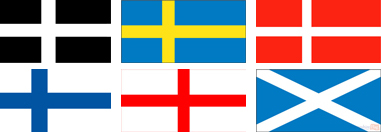 |
| First row: Cornwall, Sweden, Denmark. Second row: Finland, England, Scotland. |
We've rounded all this up mainly because, again, your editor is a big flag nerd but also because it's RCPU's position that we very much like the new Windows 8 logo. Forget about whether it has continuity with the rest of what Microsoft is doing or looks like something from 1985. This is a logo steeped in lore, which borrows from the history and tradition of some of the world's great nations. Did Microsoft intend it to be that way? We'd like to think so.
But there's more to the logo than just a resemblance to a few national flags. There's the cross. Let's set aside the religious symbolism of the cross here -- we're pretty sure Microsoft didn't mean to include any of that -- and think more of the old phrase, "We all have our crosses to bear." In the Windows 8 logo, we see represented graphically the cross Microsoft bears with Windows. Windows is old and arguably in decline, not unlike some of the cross-flagged nations whose former empires have disappeared (we won't say which ones).
Microsoft is trying to reinvent its flagship product for a brave new world, just as much of old-school Europe and the U.K. are trying to figure out how to deal with the challenges of the 21st century in the face of competition from other parts of the world. (We should perhaps note here, in case you've bothered to watch the news or follow the stock market in recent months, that the Greek flag also features a cross.)
But the Windows 8 cross (St. Ballmer's? Maybe not) also represents Microsoft's stability in a changing world. After all, Sweden, Finland, England and friends (and some auld enemies) are still around despite being tossed pretty heavily on the waves of history. And so it is for Microsoft. The company moves into the Windows 8 era with a new, and risky, version of a tried-and-true product. And while success for Windows 8 isn't guaranteed, Microsoft's survival as a big and influential software company -- and as a money-hose for its partners -- probably is.
Just as There'll Always Be an England, there will (probably) always be a Microsoft.
Like the Windows 8 logo? Hate it? Sound off below or at [email protected].
See Also:
Posted by Lee Pender on February 22, 20123 comments
Well, here's a shock. Apparently Microsoft's retail stores are somewhat less than compelling, at least according to one blogger who actually went to one (which, we're thinking, puts him in rare company indeed). Now would be a good time to note that your editor has never been to a Microsoft store. So, this entry isn't about any sort of first-hand experience. It's about what we at RCPU imagine the Microsoft store to be.
Let's get one thing straight right off the bat: Microsoft partners don't need to worry about Microsoft stores. Most of you know that by now, so we won't dwell on it here. But unless Microsoft is somehow selling SharePoint or SQL implementations from a spot at the mall (or unless they're actually trying to peddle retail software), partners don't need to do anything but sit back and observe Microsoft's foray into direct retail -- or do what everybody else will probably do and ignore it.
You've all been to the Apple store by now, surely. It's sleek. It's cool. It's that silvery gray that used to be the color of sporting excellence back before Jerry Jones ruined the Dallas Cowboys and now just symbolizes impossibly cool and mind-blowing technology. There are geniuses there, supposedly. There are most assuredly hipsters there, people so cool that their mere glances make your editor feel junior-high-level self-conscious as soon as he walks in humming some tune by Thin Lizzy or Waylon Jennings. Of Montreal? Unless you're referring to the Club du Hockey Canadien (booo!), we have no idea what you're talking about. Your editor now finds out about new musical acts only by seeing them on the "Sesame Street" videos he watches online with his 16-month-old son.
The Microsoft store cannot, surely just cannot, look or feel anything like that. We're thinking, as the Forbes blogger mentioned, that Microsoft has to be trying way, way too hard in its retail establishments. To us, though -- and remember this is all based purely on our imagination -- that means not so much trying to look like an Apple store as trying to look way too Microsoft. We're envisioning a ridiculous blast of primary colors -- yellow, red, blue and green (not a primary color, we know) everywhere. Oversized Windows logos on every available space on every wall or counter. If all the fury and rambunctiousness of a Steve Ballmer keynote could be filtered and poured into an interior space, that's what we imagine the Microsoft store looking like. In very few companies are people as hung up on themselves and their organization as are folks at Microsoft. Probably only Apple compares, but Apple has a sense of decorum.
The only part of the Microsoft store we can imagine being cool is the Xbox part, which we're figuring is pretty big. But it couldn't attract many teenagers because of the inherent lameness of the rest of the space. For some reason, we imagine Microsoft's store looking like an old Babbage's from the '80s, with packaged productivity software on shelves all over the walls and therapeutic keyboards and mice targeted to the over-75 set. Oh, sure, the real Microsoft stores are probably full of HD screens and stunning Windows Phone devices, but it's just hard to imagine Microsoft looking up to date in a physical sense. What does that say about the company? Or does it just say something about us?
We're guessing that, aside from all the primary colors (and greens, of course), Microsoft will be stuck in the '90s ambiance-wise. After all, that's when the company and the entire Pacific Northwest other than Portland arguably peaked (although the dream of the '90s is alive in Portland). We're imagining a latte bar -- Starbucks, of course, just to be slightly unfashionable and overly corporate -- and the worst of those '90s bands like the Gin Blossoms and Counting Crows playing through the store's speakers. There might even be flannel and plaid involved, just because if any company is going to be that lacking in self-awareness, it'll be Microsoft.
As for the clientele, we're seeing folks in their 40s and 50s, mostly men, mostly with burgeoning guts and bald spots -- basically slightly older versions of your editor except with thinning hair. And they won't come in and buy Windows Phone devices or tablets, should those ever exist in a Microsoft store. No, they'll go to the Apple store for that stuff like everybody else. But they will buy something -- keyboards, maybe? -- because even though Microsoft stores will never be cool, they'll be profitable. For all of Microsoft's faults -- a lack of consumer innovation, terminal uncoolness, a tendency to awkwardly try to be like Apple and fail -- if there's one thing the company still knows how to do, it's make money.
Have you been to a Microsoft store? What do you think one would be like? Leave a comment below or send your thoughts to [email protected]
Posted by Lee Pender on February 13, 20123 comments
There was a time when some Luddite editor called the iPad an "iPhone on steroids" (and didn't mean that in a nice way) and ridiculed it, wondering aloud in pixels why anybody would want this device and a smartphone and a laptop.
There was a time. That time is no more. No, your editor hasn't bought an iPad. Everybody else has, though. Recently, we found out that Apple is now the world's No. 1 PC vendor and is starting to crush it not only with consumers but also in the enterprise.
Is there anything Apple won't eventually dominate? Should we expect the score of Sunday's Super Bowl to be Patriots 23, Giants 20, Apple 517? (Reverse the Pats and Giants if you'd like. You get the point.) Will Apple now storm to the Stanley Cup, the NBA title, multiple Oscars (actually, that somehow seems possible) and, in November, the presidency? (If corporations are people, your editor would probably rather vote for the "person" that is Apple than anybody else who will be running.)
The fantastic fruit simply sweeps all before it into humble submission. Of course, it doesn't hurt that Microsoft is years behind the rest of the industry in tablets and smartphones, that HP's leaders have recently been less effective than Herman Cain's campaign manager (seriously, those ads were creepy) and that Android seemingly violates every patent ever written and besides that comes in more flavors than ketchup. (Yes, ketchup, or catsup if you prefer. Have you walked down the ketchup aisle lately? The variety on display is practically obscene. It's also a beautiful reminder that, yeah, we can do that in America -- and we will.)
Still, all credit has to go to Apple, which not only created the iPad but actually persuaded people to buy a tablet. The idea of tablet computing has been around for a very long time, and tablets have existed for a while. But they were largely useless or just thoroughly rejected until the late Steve Jobs held one up on stage that just worked. Maybe it was Jobs; maybe it was Apple, coming off the success of the iPhone; or maybe it was just because the device was really cool. Whatever the reason, Apple quickly did what once seemed impossible: It got people not just to buy, but to buy into the idea of tablet computers.
And your editor, who so blithely ridiculed the iPad when it launched, gets it now -- the tablet computing thing, that is. The iPad was a bit out of an 1105 Media editor's price range (hint, hint), but with an Amazon gift certificate and a great deal on a used device, the late, great HP Touchpad was right in the financial comfort zone. And it's awesome. (By the way, I can go ahead and expense this, right?)
No, really! webOS is a gem, and the whole tablet experience is fantastic. It's much better than reading casually on a laptop (almost impossible to do), and it's more comfortable than reading on a smartphone (just a bit too small). Your editor has lifelong problems with books and eye strain, but a tablet doesn't require the wearing of the dreaded reading glasses. Videos and music are fantastic, practically unbelievable. And now there will be a screen too keep your editor's 16-month-old son occupied -- at least for a little while -- on those long flights from Boston to Dallas-Fort Worth and back.
Of course, WebOS has no apps to speak of, so your editor is soon to embark on hacking his device to also run Android. There might be another blog entry about that to come. It's not as easy (for this blogger, anyway) as it seems to be online. The real bottom line of all this rambling is this: The Touchpad is great, really great -- and it's the device nobody bought until it got marked down to $100. It was the failure, and it's brilliant. The iPad 2 must be beyond incredible (and is, from what your editor has seen of it). The iPad 3 might bring about the end of life as we know it. And that's why people are finally buying tablets, no matter how hard some cynics tried to stem the tablet tide.
What's your tablet experience? If you don't have or want one, why not? Send your thoughts to [email protected] or sound off in the comments below.
See Also:
Posted by Lee Pender on February 01, 20122 comments
There are certain pieces of trivia that get bandied around so much that they become punch lines. At some point, they're not trivial items anymore; they're quite well known, and talking about them as if they're little-known facts makes the often-pompous speaker sound really stupid to anybody with halfway savvy ears.
A personal favorite of your editor's is the tidbit from the Super Bowl a few years back about how Jerome Bettis of the Pittsburgh Steelers was actually from Detroit and got to play (and win) his last game in his hometown. This one got tossed around so much in the sports press at the time that it has become standard comedy fodder at just about every sports-related gathering your editor attends.
Other little things like this exist outside the sporting realm. Iceland is mostly green while Greenland is mostly ice. There is no word in the English language that rhymes with orange. London Bridge is actually in Arizona. Lincoln had a secretary named Kennedy, and Kennedy had a secretary named Lincoln. (Is that one actually true? We have no idea, but that's not the point.) Google's motto is "don't be evil."
That last one is the reason why we're driveling on about this stuff. The press and the punditsphere love to mention Google's mantra as if we didn't already know what it was. Really, geniuses? Google's guiding philosophy is "don't be evil"? Wow, thanks for clueing us in on that one. Did you know that Iceland is mostly green?
Another reason why we hear the "evil" phrase a lot is because the whip-smart (not really) writers who bring it up want to make it sound ironic or, at least, ridiculous. "Hey, Google's motto is 'don't be evil,' but it turns out that Google is evil! How about that for a pithy observation! I'll bet nobody has put that one together before." But we digress a little bit.
We all know, then, what Google intends to be is, well, not "evil." But is Google evil as so many crafty wordsmiths suggest? Two recent events offer some insight into that question. First, there's Google's decision to consolidate user data across all of its services without the user being able to opt out, which is predictably driving people crazy and causing pundits to overreact and scream about privacy issues.
Let's deal with this one first. Here's our ruling: not evil. Somebody actually wrote this in the Washington Post about this story:
"But consumer advocates say the new policy might upset people who never expected their information would be shared across so many different Web sites.
"A user signing up for Gmail, for instance, might never have imagined that the content of his or her messages could affect the experience on seemingly unrelated Web sites such as YouTube."
Seriously? Does that sentence really exist in the wild? Does this mean that there's somebody out there who still doesn't understand how Google works? Google makes its money from advertising: targeted (annoying, but still targeted) advertising. That means that if you send e-mails about Lady Gaga (is she still big among the kids?), you might get an ad in your Gmail inbox touting Lady Gaga tickets or maybe a DVD, if people still buy those. Is anybody really shocked by this? Google has always worked this way.
So, now, Google's going to hook up its properties and share information among them in order to more accurately pinpoint something you might actually want to click on somewhere in a Google-run site. Your Blogger-hosted blog entry raging against Google's privacy policy might lead to an ad for tinfoil hats ending up on your YouTube site. Be vigilant.
Seriously, though, privacy is a myth. It is. There is almost nothing you can do online anymore (or anywhere, really) without somehow signing up first. And while it's true that it's your decision whether to sign up (usually, not always), the practical reality is that you can't use most services at all without at least supplying an e-mail address, usually more. So you're going to divulge something to Big Corporate Brother because that's what we have to do in order to actually use things these days. That's hardly unique to Google. That's life online. It's life, period.
As we've said here before, all kinds of organizations have tons of information about you, anyway, unless you really are hiding out Unabomber-style in a cabin in the woods somewhere, in which case you're not reading this, anyway. Cable companies and Internet providers, for instance, use Social Security numbers for identification. That's the key to the kingdom right there, and yet we give it away because that's what they make us do. Doing anything else is prohibitively difficult, if not impossible. Let's not even get into what credit reporting agencies and credit card providers know about us. Sometimes your editor has trouble answering those "security questions" about his own life. And we're really worried about Google combing our Gmail activity and our YouTube browsing habits? Really?
Here's another point we'll reiterate in this space: Google isn't out to get you (usually -- stay tuned). Google wants you to buy stuff from its advertisers. It is not circling your house with black helicopters or peeking in your windows (although it might peek in your Windows a bit, heh heh). It is not trying to rip you off or take away your liberties or destroy your reputation. It is not working for the government or Interpol or Occupy or the Tea Party. It's trying to make a buck out of your browsing habits. If you don't like that, don't use Google -- but good luck finding somebody else that doesn't do the same thing. It's not evil; it's just business.
This next bit, though, is evil, and it's pretty remarkable. We at RCPU had forgotten -- maybe we never even knew -- that Google paid a $500 million fine to the U.S. government last year in order to escape prosecution for playing a role in illegal online pharmaceutical sales. Anyway, that happened, and we're actually left to wonder a bit how a corporation can just pay its way out of prosecution when a person probably wouldn't legally be able to do that. Aren't corporations people, my friend? Again, we digress. (And your editor is a genuine political moderate who claims no party, in case you were wondering.)
What's remarkable here is the tale, told by the Wall Street Journal, of how a federal prisoner busted Google -- and of just how far Google went in order to work around the law and grab revenue from advertising that seemed dodgy at best and was, in fact, illegal. These were ads for narcotics, steroids and other such pharmaceutical items, and the ads were worded such that it was pretty obvious that they were illegal. But did that stop Google? No. Oh, no. In fact, quoth the WSJ:
"The government's case also contained potentially embarrassing allegations that top Google executives, including co-founder Larry Page, were told about legal problems with the drug ads.
"Mr. Page, now Google's chief executive, knew about the illicit conduct, said Mr. Neronha, the U.S. attorney for Rhode Island who led the multiagency federal task force that conducted the sting.
...
"Mr. Neronha declined to detail the evidence, which was presented in secret to a federal grand jury. Other people familiar with the case said internal emails showed Sheryl Sandberg, a former top Google executive who left in 2008 for Facebook Inc., had raised concerns about the ads.
"Prosecutors could have used that evidence to argue Google deliberately turned a blind eye to lawbreaking to protect a profit stream estimated by the government in the hundreds of millions of dollars.
"Ms. Sandberg declined to comment through a spokesman. Mr. Page also declined to comment."
Yeah, we bet he did decline! Our verdict on this is swift and sure: evil. This is just plain, old greed gone wild and wrong. Read the whole WSJ story; it's long, and we don't really have the inclination to recap it here. Suffice it to say, though, that this isn't just about some oversight or sloppiness on Google's part. No, it was about finding ways to blatantly break the law in order to keep the stream of money flowing.
There's nothing trivial -- and a lot that's evil -- about that. So, while we're not panicking about Google's privacy policy (although the company dealt its trustworthiness a major blow with the drug-ads scandal), we do believe, as always, in keeping an eye as best we can (as everybody should) on corporate activities. Don't be evil, Google. And don't be lazy, users. Just don't be paranoid, either.
What's your take on Google's privacy policy? Leave a comment below or send it to [email protected].
See Also:
Posted by Lee Pender on January 26, 20124 comments
By his high standards -- maybe even by the average quarterback's mediocre standards -- Tom Brady had a bad game Sunday. But the Patriots are still going to the Super Bowl.
OK, so there was a missed field goal that half the Redmond Media Group staff could have made. There was a controversial non-touchdown non-catch. There were some things that broke New England's way. But let's put all that aside right now and consider this, briefly: The Patriots won with defense and the running game, essentially. Hall of Fame quarterback Brady was more or less just another cog in the machine.
For you folks who don't like sports (or the Pats), here comes the segue: Microsoft pulled a Patriots with its last earnings report, even before the Pats won with a mediocre Brady on Sunday. In last week's earnings roundup, the big news was that Windows revenue had slipped in Redmond. The superstar, the grizzled veteran, the money machine, was showing its weakness. Time to panic, right? Surely the decline of the PC and the rise of the iPad were conspiring to sink Microsoft. This was another nail in Microsoft's coffin. Wasn't it?
Actually, it wasn't. Microsoft beat Wall Street's expectations, and, initially anyway, its long-stagnant stock price experienced a nice little pick-me-up. Windows loses and Microsoft wins. How is it even possible? Who thought Microsoft could succeed financially without Windows carrying the load?
Well...we did, actually. Yes, here at RCPU, we've been saying for a long time that Microsoft should focus more on the enterprise and less on consumers. And sure enough, the business division (basically Office, which obviously appeals to businesses and consumers), and the server and tools division (operating systems for old iron -- think Windows Server) played the roles of Vince Wilfork and BenJarvus Green Ellis and stepped in to fill the void.
As usual, we couldn't be right about anything without a huge caveat. The overwhelmingly consumer-driven entertainment and devices division (Xbox, Kinect, Zune...just kidding about that last one) was also a huge moneymaker in Microsoft's last quarter. We've been kind of unenthusiastic about the whole Xbox thing, given how long it took to turn a profit -- but here it is raking in the green. So, there you go.
Now, let's make a couple of things clear (at the risk of sounding like Richard Nixon): The Pats will need Tom Brady to play much better than he did on Sunday in order to have any hope of winning the Super Bowl, and Windows 8 needs to be a winner for Microsoft on multiple levels. Both have a strong possibility of happening, although that Giants' front seven is terrifying. But we digress.
The greater point here is that the New England Patriots and Microsoft are both strong enough and resilient enough to overcome disappointing performances from their stars. So, for those who so giddily like to predict the decline of the Pats or the death of Microsoft (as neither organization tends to be all that popular from what we can tell), tap those metaphorical brakes a bit. In fact, slam them on. The Pats can win with a mediocre Ton Brady, and Microsoft is more than just Windows. If we've learned nothing else since last Thursday afternoon (and we probably haven't), we know that.
See Also:
Posted by Lee Pender on January 23, 20129 comments
We at RCPU have been trying not to notice election season, but given that it seems to have been upon us since approximately March 2008, we do see signs of it here and there. Now that we're actually in the pig trough of a presidential-election year, we like to think back on some of the great campaign pitches of the past, back when times were simpler and TV was awesome. Of them, one stands out above all others.
It's morning again in America. Good heavens. Ronald Reagan's 1984 TV advertisement took every sappy Maxwell House coffee, long-distance calling (remember that?) and Pepperidge Farm cookie commercial of the day and rolled them all into a big, sweet sticky bun of Americana. If he'd been alive, even Norman Rockwell would have blushed a little bit at this one. Maybe.
Watch this spot wrapped inside an episode of "Family Ties," and you'll want to not only call your mother, you'll want to go to wherever she is and hug her and maybe even bake her a ham or something:
More than anything, though, you'll want to vote for Ronald Reagan -- which a lot of people did in 1984. (As for Walter Mondale, seriously, did somebody make this ad for you as a prank? You really thought this was the best way to win hearts and minds from Ronnie? Good thing there wasn't a blogosphere back then. Ouch.)
Microsoft, to its dismay, is not in 2012 where Ronald Reagan was in 1984. It's kind of where the United States was, arguably, in 1980, though -- hardly powerless, still wealthy, but kind of down and out and in a phase of self-introspection and (yes, let's say it in a Southern accent) malaise. Apple -- nothing at all like the Soviet Union, but please allow us to stretch the metaphor here -- is in the ascendancy and has eclipsed Microsoft in terms of power and prestige. (OK, so that never really happened to the United States, either, but we've typed too much to go back on this metaphor now. Just bear with us.)
But Steve Ballmer, though he has looked more Jimmy Carter than Reagan in terms of popularity in recent years, has one trick left up his sleeve. It's Windows Phone. No, really, it is! The mobile OS that keeps losing market share despite being noticeably good-looking and obviously different from anything else on the market might actually be set to make a name for itself.
Finally -- and we're really not sure what took so long, given that we've been saying for a long time that Windows Phone looks fantastic -- critics and the press are starting to see the beauty (yes, beauty) of Microsoft's mobile operating system. Even Wall Street types are starting to take notice, something Microsoft desperately needs as it tries to jolt its years-stagnant stock price. (Thanks to Jeff Schwartz, RCPmag.com legend, for the links, by the way.)
The unemployment rate was 7.2 percent in November 1984, almost exactly what it had been in November 1980 (7.5 percent), when Reagan easily dusted Carter in the presidential election. In the years between '80 and '84, it had actually gotten much worse and then started to fall again (at least that's what this chart says, anyway). But gosh darn it, it was morning again in America, and people felt good about themselves. More often than not, perception is reality.
We're not trying to make any sort of political statement here at all, by the way. We're just saying that Microsoft needs a Reagan '84 moment, and the combination of Windows Phone and Windows 8 might just provide it. The company's customers and partners -- and investors -- need to see that things are looking up, that people are raising metaphorical flags and planting symbolic crops and whatnot in Redmond, and that the "good guys" (from Microsoft's perspective) haven't given up the fight with Apple and Google just yet.
We've been very skeptical here at RCPU of Microsoft's chances of succeeding with a mobile OS because of how late the company is to the market, relatively speaking, and how lame Microsoft's marketing tends to be. But if the ultimate cynics and Microsoft haters in the punditsphere are starting to see Windows Phone as something positive (even before Windows 8 comes out) -- and actually saying as much -- then Microsoft at least has a foothold of momentum, a fightin' chance in the mobile-OS game. Clearly, somebody in Redmond is finally softening up some of the pixel-stained wretches who love to slam the company (although to be clear, Microsoft never talks to RCPU about this stuff, seriously). That's a good sign for Microsoft. It needs to continue.
All Ronald Reagan needed in 1984 was a few numbers to hang his hat on and a series of commercials that could bring even the most withered skeptic to stand and salute the TV while on the brink of tears. He also had an opponent who was mostly incompetent in running a presidential campaign. (Surprisingly, "I'll raise your taxes" didn't resonate with anybody outside of Minnesota, but we digress.) Microsoft is not so blessed to have a goofy adversary. Apple and Google are terrifying. But if Microsoft can even establish a respectable third place in the mobile market in 2012, it'll be back in the game and back in users' minds as an innovative company with interesting products.
Is it morning again in Redmond? It's still pretty dark from where we're looking, but we might just see the fingers of dawn beginning to grasp the horizon.
Is Microsoft going to "come back" as a consumer force with Windows Phone and Windows 8? Sound off at the comments section below or at [email protected].
Posted by Lee Pender on January 11, 20126 comments